O POVO+
The energy transition has ceased to be merely an environmental issue and has become an agenda for economic development and social inclusion. In a scenario marked by the search for sustainable solutions, the advancement of renewable sources has shown potential not only to reduce emissions, but also to generate employment, income, and opportunities in historically less favored regions. In an interview with this column, the executive president of the Brazilian Association of Wind Energy and New Technologies (ABEEólica), Elbia Gannoum, highlights that the concept of “just energy transition” gained strength after the Paris Agreement and presupposes the migration to a decarbonized economy without leaving anyone behind. According to her, the impacts can already be measured. “We have data on the GDP of the Northeast region, which grew 21% due to the arrival of wind energy, and the HDI grew 20%. The potential of renewable energies is a potential for economic growth, but mainly for economic and social development,” she says.
The executive also draws attention to the role of technology in this transformation. The digitization of wind farms, smart meters, and the increasing use of artificial intelligence are expanding the efficiency of energy generation and operation. For Elbia, the combination of renewable energy and information technology will be one of the pillars of the new global economy, especially in light of the expansion of data centers and the growing demand for clean energy. The topic will be debated at the III ESG O POVO Forum, which takes place on June 25th at Fiec. ABEEólica will be represented by Felipe Vieira, the entity’s ESG specialist, on the panel “Smart technology, real impact: how AI redefines ESG in Brazil”.
Metrics in Focus
Natura released its 2025 Integrated Report, highlighting significant progress in its ESG agenda and the launch of Vision 2025-2050: Paths to Regeneration. The company has committed to becoming a 100% regenerative company by 2050 and has already achieved targets set for the coming years ahead of schedule. Among the results are the expansion of its portfolio to 52 bio-ingredients from the Amazon, the use of 30.1% recycled plastic in packaging, the certification and traceability of 100% of critical supply chains, and the expansion of partnerships to 46 agro-extractive communities in the Amazon region.
The report also points to the consolidation of goals already achieved, such as salary parity by gender and race and the presence of 50% women in senior leadership. In 2025, the company generated R$ 86.8 billion in positive socio-environmental impact, reduced its absolute carbon emissions by 17%, and achieved 94.7% renewable ingredients and 97.6% biodegradable formulas in rinse-off products. Direct investment in Amazonian communities reached R$ 62.39 million, a 29% increase compared to the previous year.
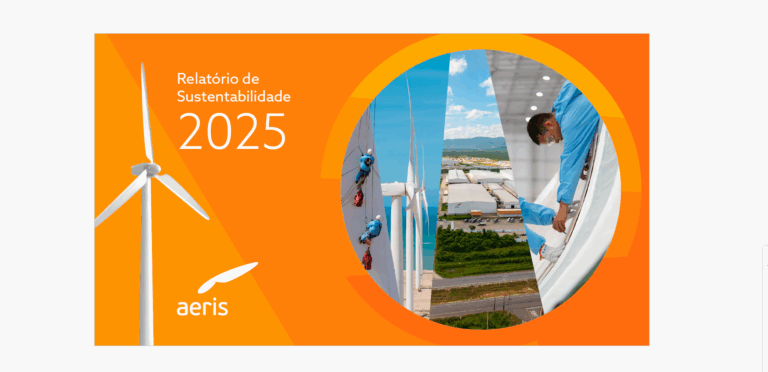
Energy, in its 2025 Sustainability Report, records advances in operational efficiency, innovation, and sustainability, even in the face of the challenges faced by the Brazilian wind energy industry. The company maintained zero Scope 2 emissions for the third consecutive year, produced 324 wind turbine blades, achieved 1.3 GW in contracts, and ended the year with 1.0 GW in projects under negotiation.
The document also highlights investments in new technologies, such as drones and robots for asset inspection, record results in quality audits, and the expansion of Services, which now represents 22.1% of the company’s net operating revenue. The unit has expanded its operations to ten countries and is advancing in the implementation of a training center in the United States, reinforcing the strategy of diversification and international growth.
Service
III ESG Forum O POVO
Date: June 25, 2026
Location: Fiec – Waldyr Diogo Auditorium
Free and limited registration via Sympla